 Skip to content

Modern organisations are experiencing a significant shift in workforce composition. For the first time in history, up to four generations are working side by side, each bringing unique experiences, perspectives, and strengths to the table.
This creates both opportunity and complexity within any diverse workplace.
From communication preferences and technology adoption to leadership expectations and career aspirations, generational differences are easy to spot. Some employees value structure, stability, and clearly defined processes, while others thrive on flexibility, rapid feedback, and digital-first collaboration.
For some organisations, these differences create friction. For others, they create a competitive advantage.
The reality is simple: Age diversity in the workplace is not a challenge to manage. It is a strategic advantage to leverage.
Businesses that learn how to unite different generations around shared goals gain access to a broader range of skills, perspectives, and ideas, creating stronger teams and better business outcomes.
Why Does Age Diversity Matter in the Workplace
Age diversity in the workplace creates stronger teams by combining experience, fresh thinking, adaptability, and institutional knowledge, leading to better decision-making, innovation, and long-term performance.
Every generation contributes something valuable.
More experienced professionals often bring strategic insight, industry expertise, and a deep understanding of what has worked in the past. Younger employees frequently contribute new perspectives, digital fluency, and an ability to adapt quickly to emerging technologies and trends.
The goal is not to create uniformity. The goal is to create alignment.
When organisations build systems that allow different generations to collaborate effectively, they unlock far more value than any single demographic could provide alone.
Understanding the Four Generations in a Modern Workplace
Building a successful age-diverse workplace starts with understanding the people within it.
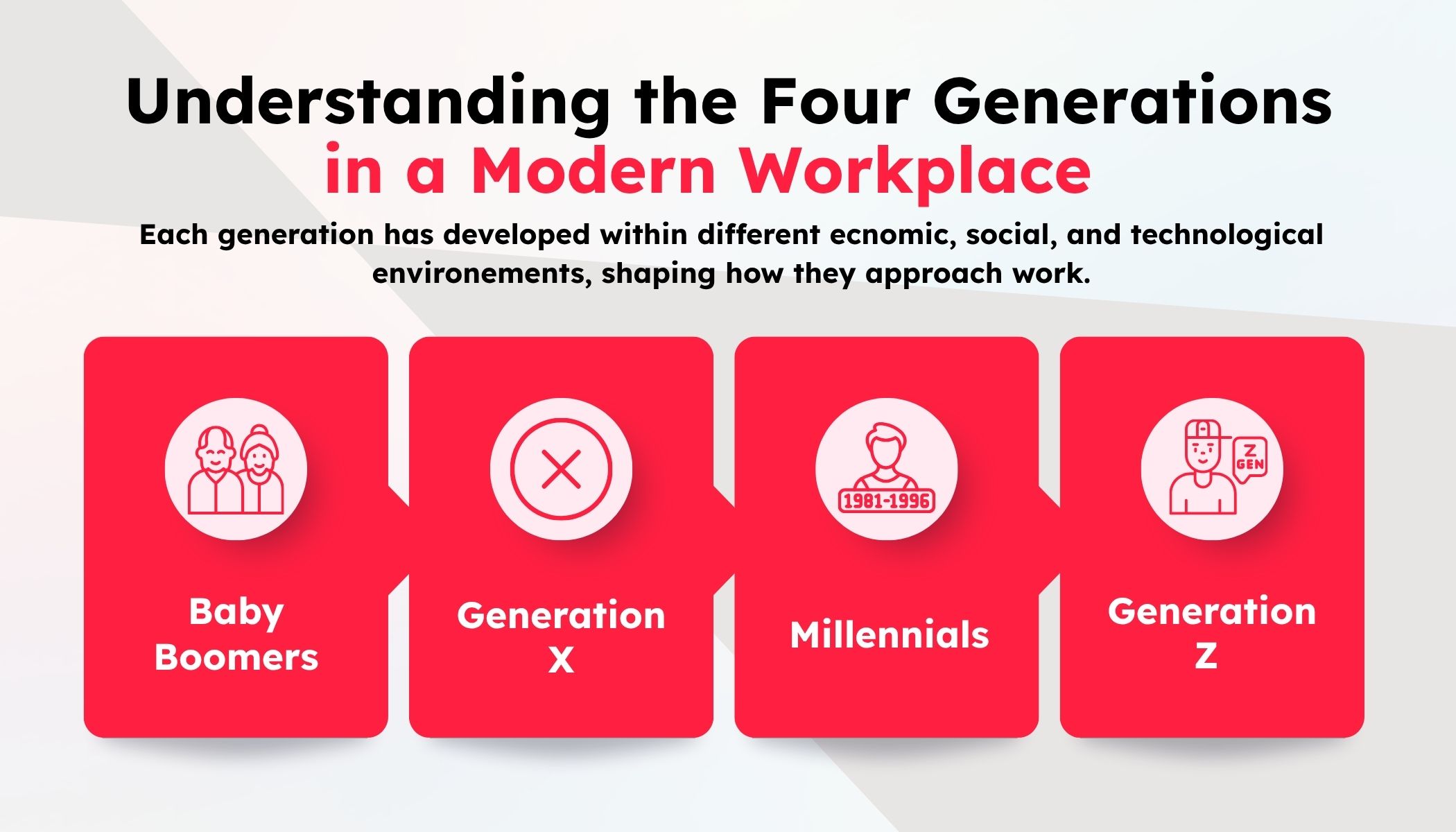
Most organisations today include employees from four generations:
- Baby Boomers
- Generation X
- Millennials
- Generation Z
Each generation has developed within different economic, social, and technological environments, shaping how they approach work.
Differences often appear in:
- Communication styles
- Workplace expectations
- Technology adoption
- Learning preferences
- Career ambitions
- Leadership expectations
For example, experienced professionals may place a higher value on structure and stability, while younger generations often prefer agility, collaboration, and continuous feedback.
Rather than viewing these differences as obstacles, organisations should recognise them as complementary strengths that contribute to a stronger and more resilient workforce.
Where Friction Happens in An Age-Diverse Workplace
While the benefits are significant, age diversity does introduce challenges that leaders must address.
Common sources of friction include:
- Formal versus informal communication styles
- Different expectations around feedback
- Varying attitudes toward hierarchy
- Different levels of comfort with technology
- Different perspectives on productivity and work-life balance
When left unmanaged, these differences can create misunderstandings and slow collaboration.
However, the key insight is this: Differences only become problems when they are not understood.
When employees appreciate and respect different approaches, diversity becomes a strength rather than a source of conflict.
Teams become more adaptable, innovative, and capable of solving complex problems from multiple angles.
The Benefits of Age Diversity in the Workplace
The benefits of age diversity in the workplace extend far beyond culture and inclusion initiatives. They have a direct impact on business performance.
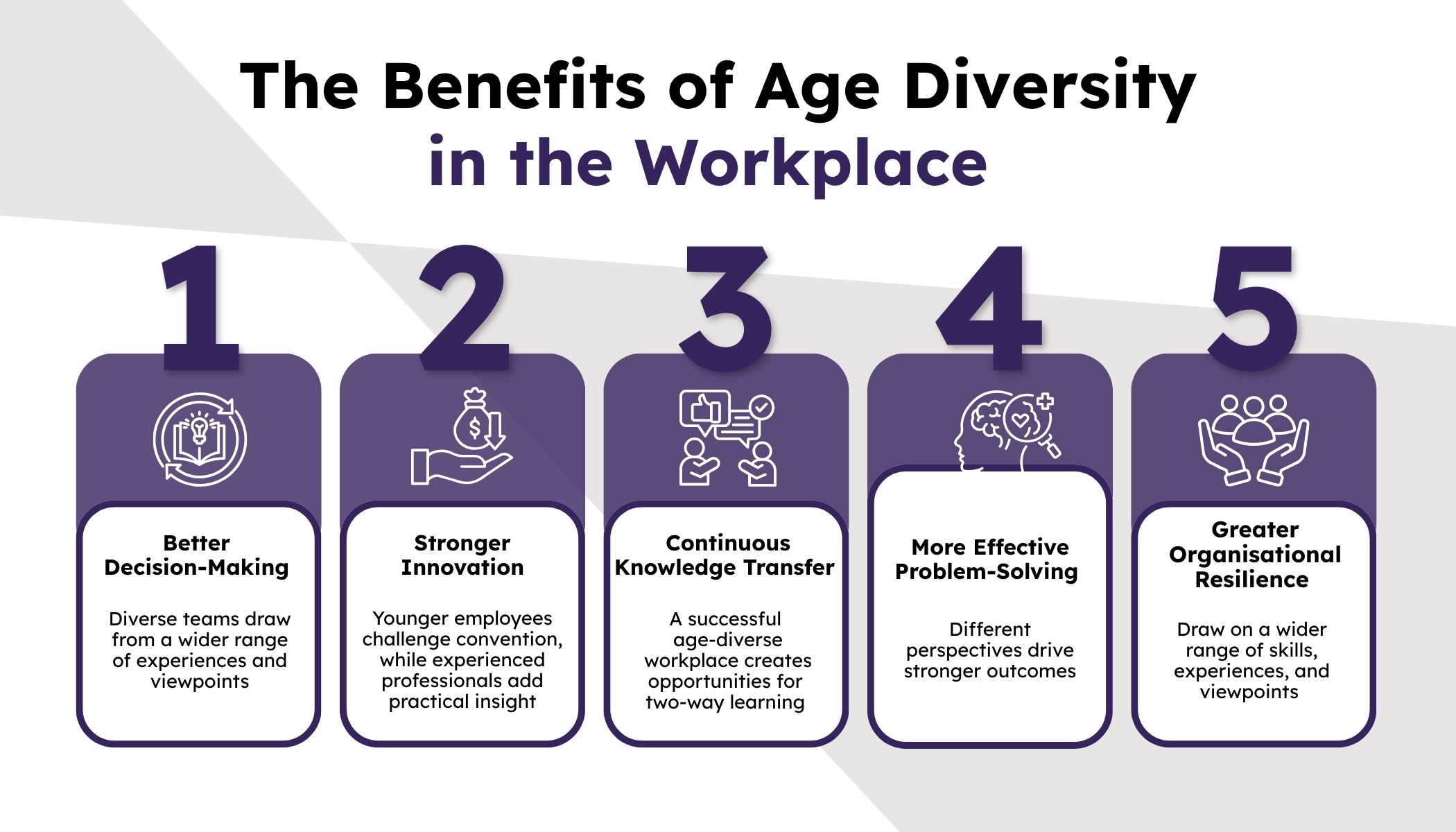
Better Decision-Making
Diverse teams draw from a wider range of experiences and viewpoints.
This reduces blind spots, challenges assumptions, and leads to more balanced decisions.
Stronger Innovation
Innovation thrives when fresh ideas meet practical experience.
Younger employees often challenge traditional thinking, while experienced professionals help refine ideas into realistic and effective solutions.
This combination produces innovation that is both creative and executable.
Continuous Knowledge Transfer
A successful age-diverse workplace creates opportunities for two-way learning.
Experienced employees share industry knowledge, professional expertise, and historical context.
Younger employees introduce new technologies, digital tools, and emerging trends.
Everyone benefits.
More Effective Problem-Solving
Complex challenges rarely have simple solutions.
Teams with diverse perspectives approach problems differently, resulting in more comprehensive and effective outcomes.
Greater Organisational Resilience
Businesses that embrace diversity in workplace thinking are often better equipped to adapt to change because they can draw on a wider range of skills, experiences, and viewpoints.
In short, the benefits of age diversity in the workplace directly influence innovation, adaptability, and long-term success.
How Different Generations Collaborate Productively
For an age-diverse workplace to succeed, collaboration must be intentional.
Successful collaboration is built on three foundations:
- Clarity
- Respect
- Shared goals
Without clarity, misunderstandings emerge. Without respect, differences become barriers.
When both exist, diversity becomes a multiplier.
Practical ways to strengthen collaboration include:
- Encouraging cross-generational knowledge sharing
- Creating structured opportunities for teamwork
- Supporting different working styles
- Establishing clear communication expectations
- Focusing teams on shared outcomes
The objective is not to standardise behaviour.
It is to unite different strengths behind a common purpose.
Leadership in an Age-Diverse Workplace
Leadership plays a critical role in unlocking the value of diversity in workplace environments.
Today’s leaders must be capable of adapting to:
- Different communication preferences
- Different learning styles
- Varying expectations around autonomy
- Different approaches to feedback and recognition
This requires:
- Flexibility
- Empathy
- Clear communication
- Emotional intelligence
A one-size-fits-all leadership style is no longer effective.
Instead, leaders must create environments where every employee can contribute at their highest level, regardless of age or experience.
The goal is not to manage differences. The goal is to enable them.
How Ruby Digital Makes Diversity in the Workplace a Strength
At Ruby Digital, diversity in the workplace strategy is embedded into the way the organisation operates.
The team includes individuals with diverse backgrounds, experience levels, and perspectives. This diversity is actively embraced because it contributes directly to stronger outcomes for both employees and clients.
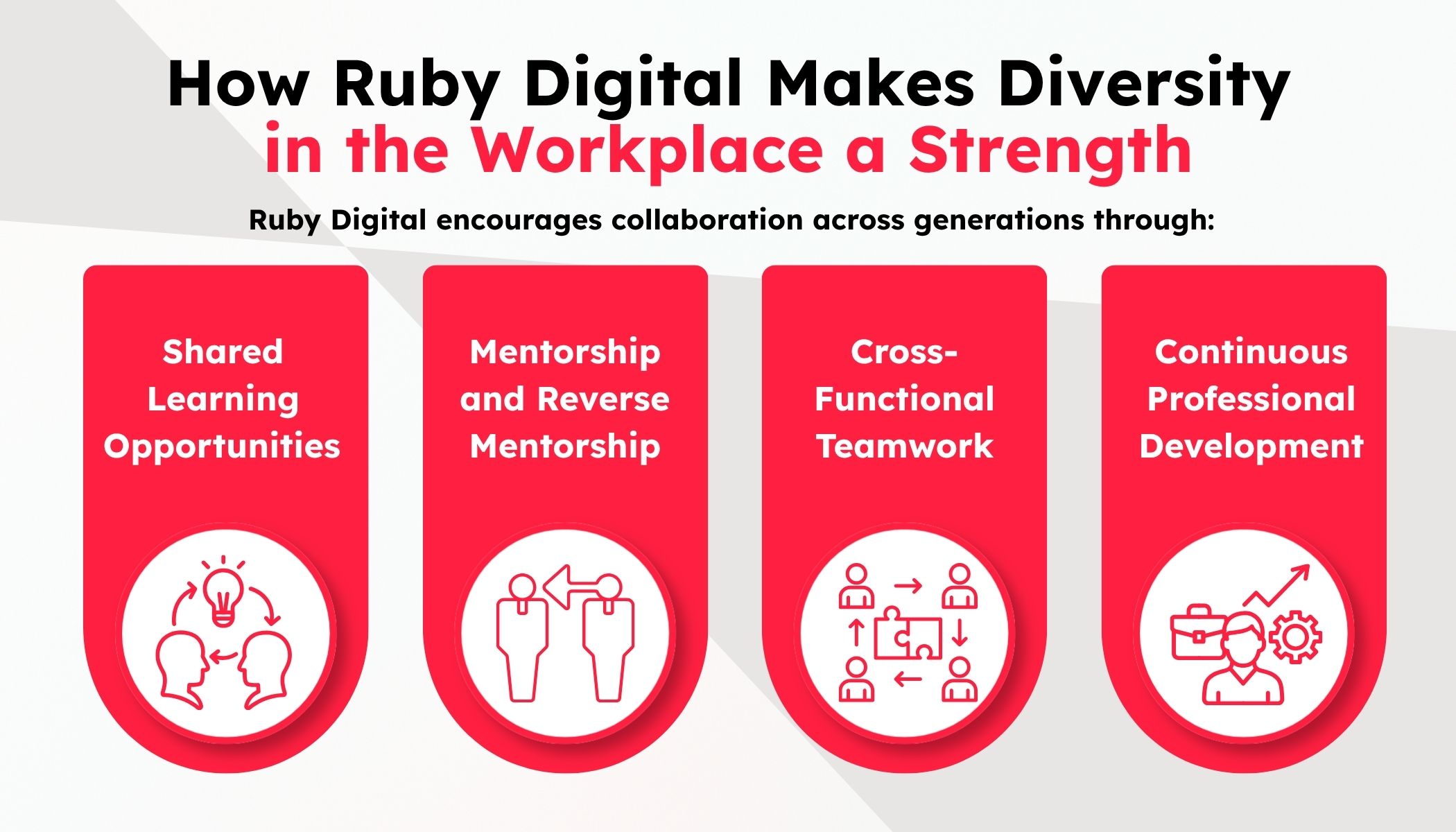
Ruby Digital encourages collaboration across generations through:
- Shared learning opportunities
- Mentorship and reverse mentorship
- Cross-functional teamwork
- Continuous professional development
Team members are encouraged to:
- Learn from one another
- Share knowledge openly
- Challenge assumptions respectfully
- Contribute ideas regardless of tenure
This approach aligns closely with Ruby Digital’s people-first culture and commitment to continuous growth.
By creating an environment where learning never stops, Ruby Digital helps employees remain adaptable, innovative, and future-ready. It also reinforces the importance of long-term growth strategies.
Leadership frameworks, including strategic advisory models such as FxCMO, further support alignment across teams, ensuring that diverse perspectives contribute to shared business objectives.
The result is a workplace where age diversity becomes a catalyst for innovation rather than a barrier to productivity.
Why Age Diversity Is a Competitive Advantage
From a business perspective, an age-diverse workplace delivers measurable advantages.
Organisations with age-diverse teams are often better positioned to:
- Adapt to market changes
- Solve complex challenges
- Make stronger strategic decisions
- Build resilient teams
- Foster innovation
Age diversity also contributes to:
- Higher employee engagement
- Greater creativity
- Stronger collaboration
- Improved long-term performance
Rather than slowing organisations down, diversity strengthens their ability to respond to uncertainty and seize new opportunities.
The conclusion is clear:
An age-diverse workplace creates stronger, more future-ready businesses.
The Future of Work Is Multi-Generational
Workplaces will only become more diverse as career spans lengthen, and technology continues to evolve.
Multiple generations working together are no longer a temporary trend. It is the future of work.
Businesses that embrace this reality will:
- Attract stronger talent
- Retain valuable knowledge
- Improve adaptability
- Build more resilient cultures
Those that fail to do so risk falling behind.
The future belongs to organisations that can unite different generations around shared goals and shared success.
Diversity Is Not a Challenge; It’s an Improvement
At its core, the message is simple: Age diversity in the workplace strengthens teams by combining experience, innovation, wisdom, and adaptability.
It is not something to minimise. It is something to activate.
The most successful organisations understand that differences are not obstacles to overcome. They are advantages waiting to be leveraged.
The businesses that thrive in the years ahead will not be the ones that reduce differences.
They will be the ones that use those differences to outperform the competition.