 Skip to content

Keeping an eye on competitors has always been essential to business strategy. But today’s markets move quickly, making traditional competitor monitoring increasingly difficult. Competitors constantly adjust their campaigns, pricing, messaging, services, and content strategies. At the same time, businesses are expected to monitor more channels and process more information than ever before.
Manual monitoring simply cannot keep pace. By the time a business identifies a competitor’s shift, that competitor may already be gaining traction. AI changes the equation. It enables continuous monitoring, identifies meaningful changes faster, and transforms competitor intelligence from a reactive process into a proactive growth strategy.
What Is AI-Powered Competitor Intelligence?
AI-powered competitor intelligence uses artificial intelligence to monitor competitor activity, analyse market changes, identify opportunities, and generate insights that support faster business decisions.
Instead of relying on periodic reviews, AI can continuously evaluate multiple data sources to:
- Process large volumes of information
- Detect trends and patterns
- Highlight meaningful changes
- Identify actionable opportunities
The result is greater market awareness, faster decision-making, and a stronger competitive advantage.
Why Traditional Competitor Monitoring Often Falls Short
Traditional competitive intelligence often depends on manual reviews, quarterly audits, ad-hoc reports, and individual observations. While useful, these approaches have limitations.
Information becomes outdated quickly; important changes can be missed; and teams have limited capacity to monitor multiple competitors simultaneously.
A competitor can change its pricing, launch a campaign, or reposition an offering overnight. Waiting weeks to identify that shift leaves businesses responding after the market has already moved. Effective competitor intelligence needs to keep pace with change.
How AI Transforms Competitor Intelligence
AI increases both the speed and scale of competitor monitoring.
It can analyse large datasets, multiple competitor sources, market signals, and digital engagement patterns continuously. This enables businesses to identify trends earlier and gain competitive insights that support stronger strategic decisions.
Rather than simply observing what competitors have already done, businesses can understand what those changes mean and decide how to respond.
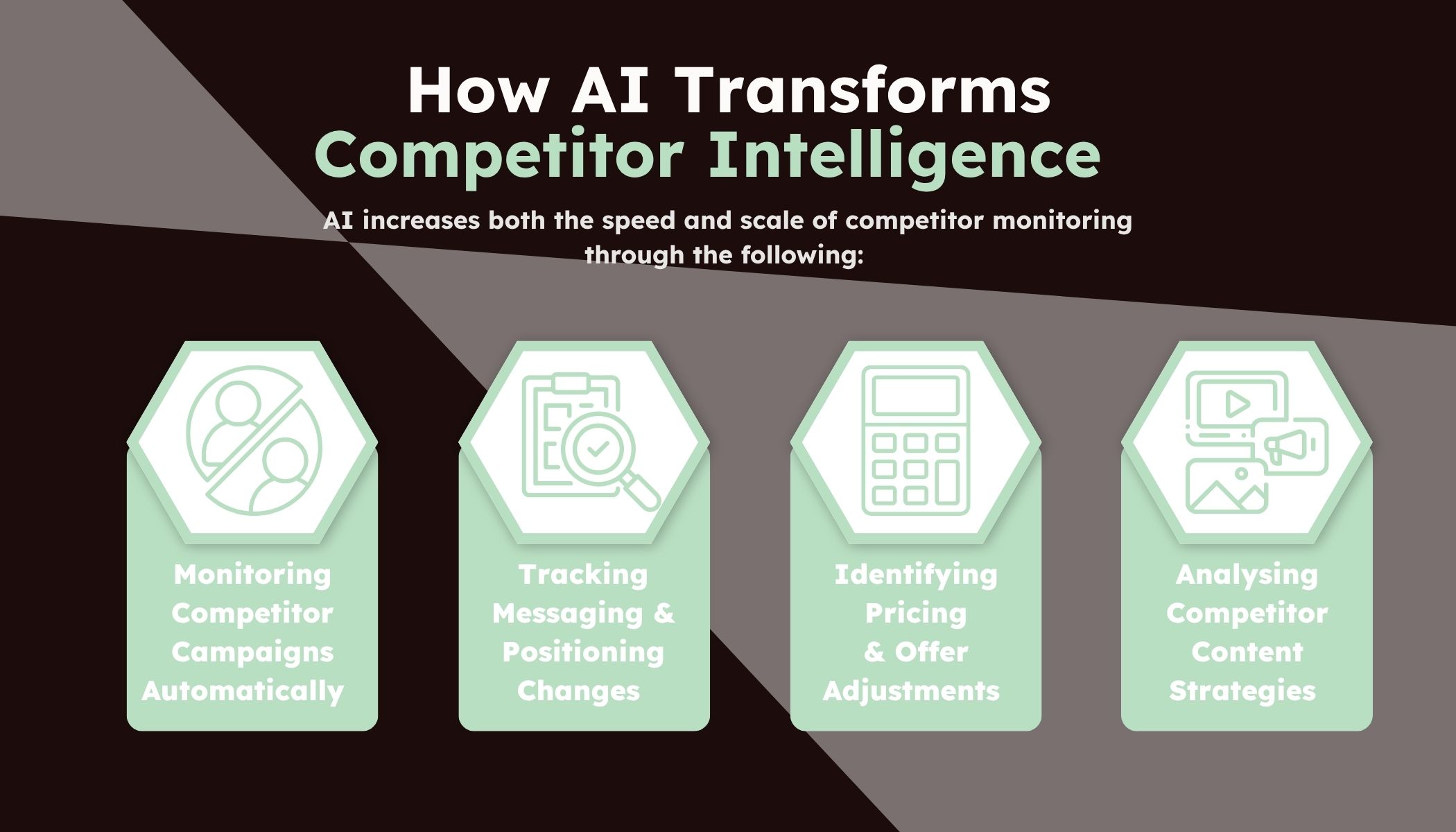
Monitoring Competitor Campaigns Automatically
One of the most practical applications of AI competitor analysis is campaign monitoring.
AI can identify changes across paid advertising, promotional messaging, creative strategies, and marketing channels. Businesses can gain earlier visibility into new campaigns, seasonal promotions, messaging updates, and shifts in audience focus.
These insights support faster strategic adjustments and stronger campaign planning. When businesses understand how competitor campaigns are evolving, they can respond to market changes with greater speed and confidence.
Tracking Messaging and Positioning Changes
Competitor messaging can reveal important clues about where the market is heading.
AI can analyse websites, landing pages, digital advertising, social media, and other public content to identify shifts in positioning and communication. If several competitors suddenly focus on themes such as automation, sustainability, or AI adoption, this could indicate changing buyer priorities, business challenges, or emerging demand.
AI makes these patterns easier to identify at scale, helping businesses understand market direction before trends become obvious.
Identifying Pricing and Offer Adjustments
Pricing changes can signal increased competition, market pressure, client acquisition strategies, or changes in positioning.
AI can monitor:
- Pricing updates
- Package changes
- Promotional offers
- Discount structures
These competitive insights help businesses understand how competitors are influencing buying decisions across target accounts and decision-making teams.
Instead of reacting after market conditions change, organisations can evaluate their pricing and commercial strategy earlier, protecting their position and identifying opportunities to compete more effectively.
Analysing Competitor Content Strategies
Content is often an early indicator of strategic direction.
Competitors may signal new priorities through their content long before launching a product, service, or major campaign. AI can analyse publishing frequency, topic selection, content gaps, emerging themes, and SEO targeting trends.
This helps businesses identify:
- Underserved topics
- New content opportunities
- Growing client interests
- Emerging industry conversations
For organisations investing in SEO, this intelligence can reveal opportunities to establish authority before competitors dominate valuable topics.
How AI Helps Identify Opportunities, Not Just Threats
Competitor monitoring should not only be defensive. Advanced competitor intelligence can uncover market gaps, underserved audiences, emerging trends, content opportunities, and areas where competitors are failing to address buyer requirements or business needs.
This changes the strategic question from, “What are our competitors doing?” to, “Where are they leaving opportunities behind?”
The greatest value of competitive intelligence may be discovering what competitors are not doing.
Businesses that identify those gaps early can create new opportunities rather than simply responding to existing competition.
The Role of Competitor Intelligence in Strategic Decision-Making
Intelligence only creates value when it leads to action.
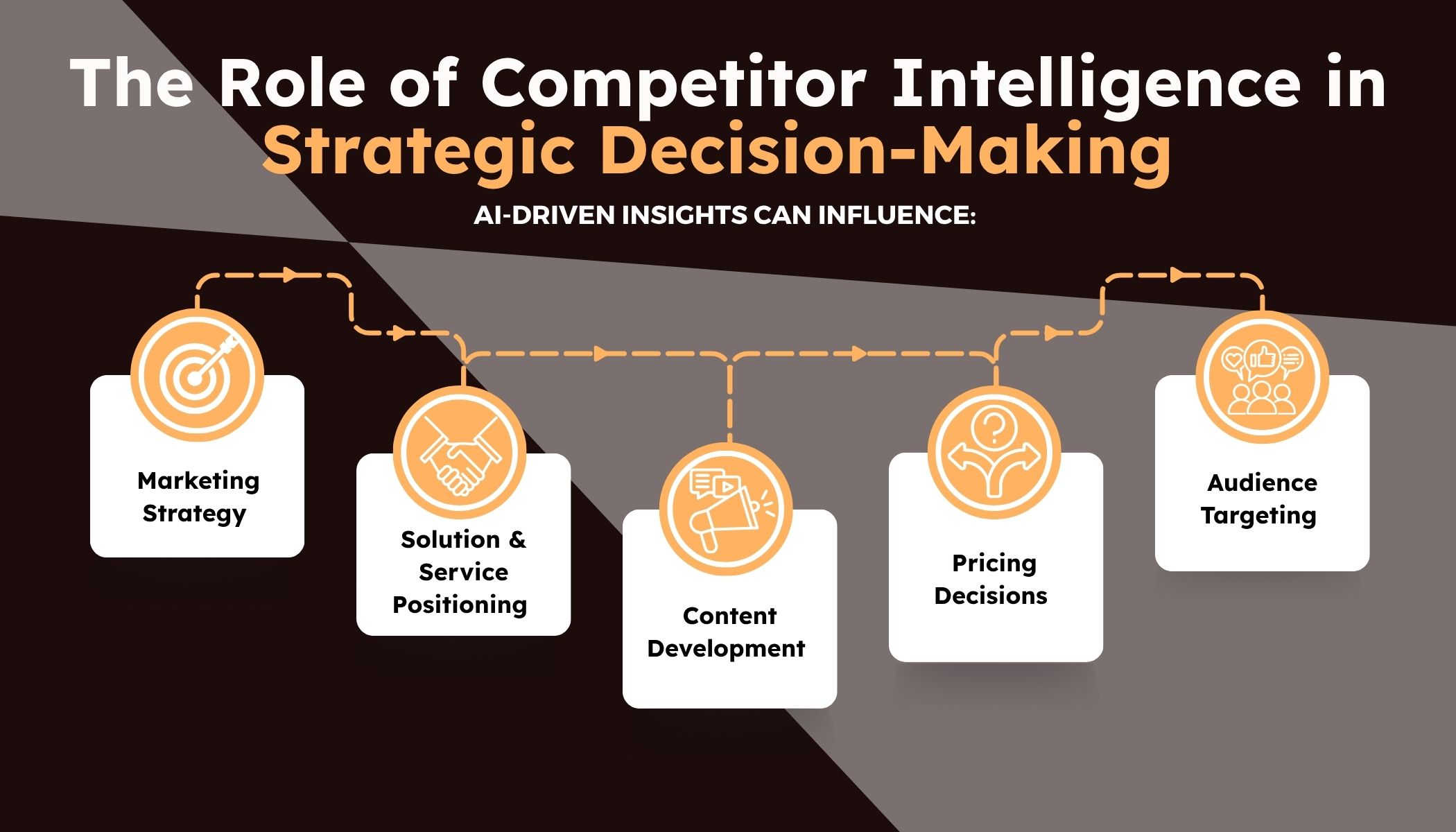
AI-driven insights can influence:
- Marketing strategy
- Solution and service positioning
- Content development
- Pricing decisions
- Audience targeting
With greater visibility into competitor and market activity, businesses can make informed decisions about where to invest resources. This replaces assumptions with evidence, supporting faster strategic responses, stronger positioning, and better resource allocation.
How AI Strengthens Business Intelligence
Effective business intelligence competitor strategies require more than analysing internal performance. AI can connect competitor activity and market signals with buyer behaviour, market demand signals, and internal performance metrics.
Businesses can see their own position alongside industry shifts, competitor movements, and emerging opportunities.
Combining internal performance with external intelligence creates the context needed to make smarter long-term decisions.
How Ruby Digital Approaches AI-Driven Competitive Intelligence
Ruby Digital combines FxCMO consulting, native-AI, proprietary technology such as RubyLeads© and RubyReports© analytics, and strategic research to help companies understand their competitive landscape and uncover growth opportunities.
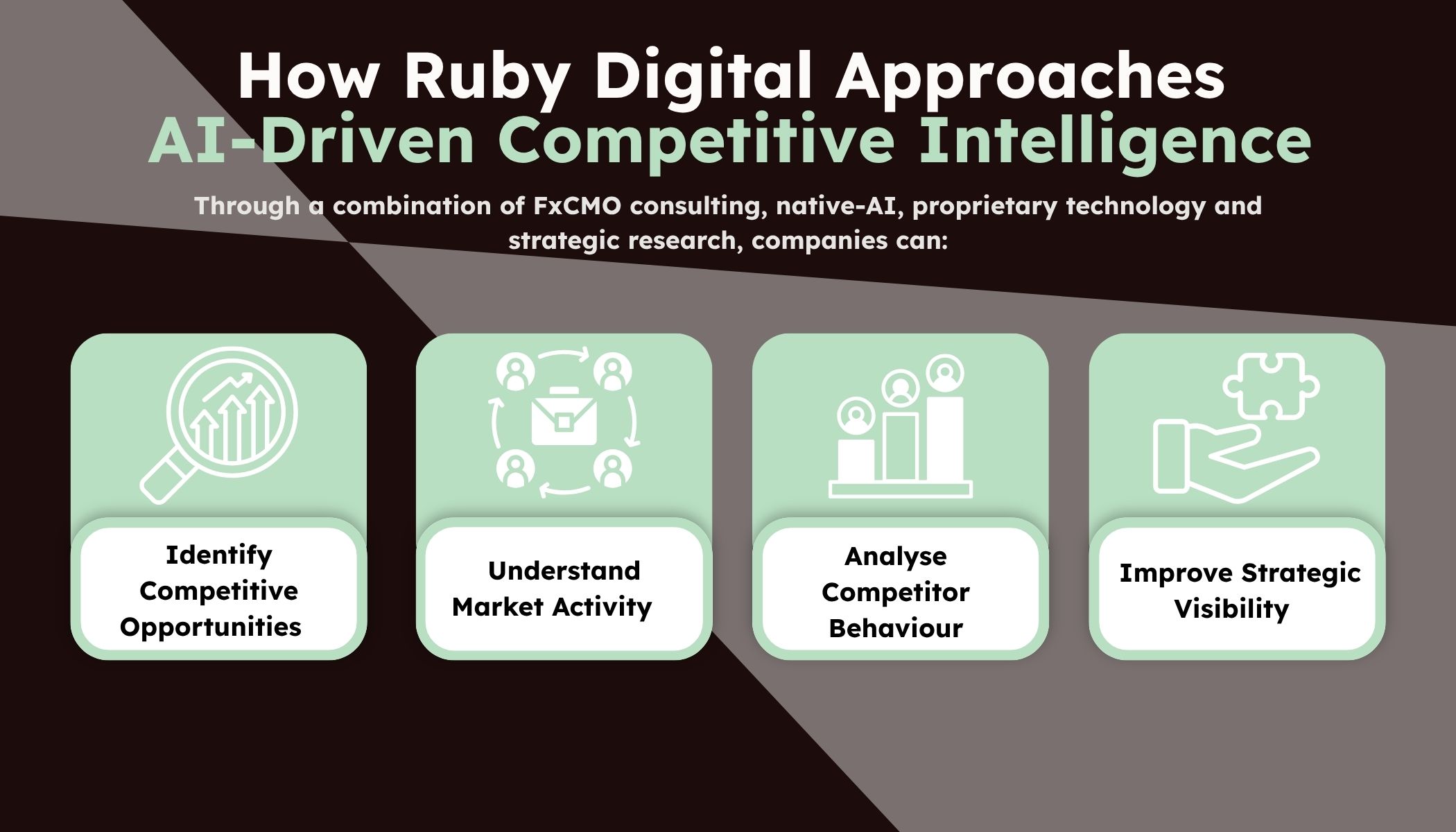
The approach focuses on helping businesses:
- Identify competitive opportunities
- Understand market activity
- Analyse competitor behaviour
- Improve strategic visibility
This includes:
- Competitor analysis
- Market monitoring
- AI-driven insight generation
- Opportunity identification
By combining technology with strategic expertise, businesses can move beyond simple monitoring and begin making intelligence-led decisions.
Organisations seeking a deeper understanding of competitor activity can also benefit from structured approaches. These insights can then inform broader positioning initiatives and market strategies.
The Future of Competitor Intelligence Is Predictive
The next stage of competitor intelligence is prediction.
As AI capabilities advance, businesses will increasingly be able to anticipate competitor actions, forecast emerging trends, identify market shifts, and uncover opportunities earlier.
Competitive analysis will become more proactive, helping businesses move from understanding what competitors have done to anticipating what they may do next.
This creates a powerful competitive advantage. Businesses that recognise change early have more time to respond, adapt, and lead
Competitive Advantage Belongs to the Informed
AI-powered competitor intelligence gives businesses the ability to monitor competitors, identify emerging opportunities, and make smarter decisions faster.
Success in competitive markets requires more than collecting information. It requires continuous monitoring, strategic interpretation, market awareness, and decisive action.
AI makes it possible to uncover competitive insights that would be difficult or time-consuming to identify manually. The businesses that use those insights effectively can respond faster, position themselves more strategically, and invest resources where they have the greatest potential to drive growth.
Ultimately, competitive advantage belongs to businesses that turn intelligence into action.
The winners will not necessarily be the organisations with the most data. They will be the ones that use it to recognise opportunities and act before their competitors do.