 Skip to content

Black Friday may dominate the retail calendar, but successful peak season marketing extends far beyond a single shopping event. Cyber Monday, Christmas, payday promotions and category-specific demand spikes all create opportunities for e-commerce growth. Each brings different customer behaviours, competitive pressures and purchasing patterns.
Simply increasing advertising budgets when demand peaks is not enough. Competition intensifies, advertising costs rise, and customer intent changes quickly. Successful e-commerce marketing starts with preparation. Brands that understand demand, optimise their campaigns, and create seamless shopping experiences are better positioned to convert seasonal interest into measurable revenue.
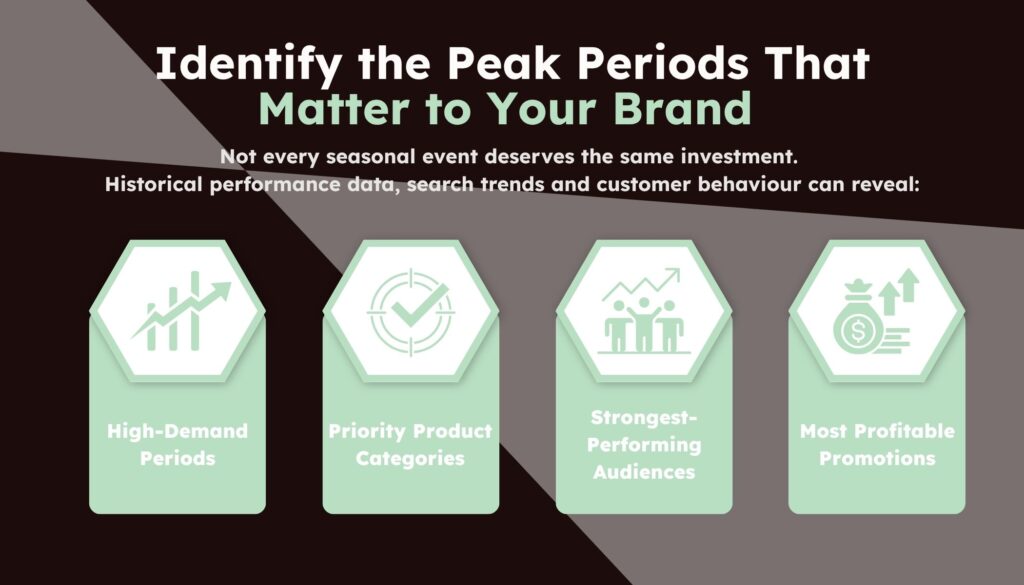
Identify the Peak Periods That Matter to Your Brand.
Not every seasonal event deserves the same investment.
Historical performance data, search trends and customer behaviour can reveal:
- High-demand periods
- Priority product categories
- Strongest-performing audiences
- Most profitable promotions
While Black Friday marketing remains important, Christmas, back-to-school or industry-specific promotions may deliver stronger returns for certain retailers. Focus investment where customer demand and commercial opportunity are greatest.
Use Previous Performance to Plan Smarter
Every campaign provides insights that can strengthen future results.
Review key performance marketing metrics, including:
- Return on ad spend (ROAS)
- Cost per acquisition (CPA)
- Conversion rates
- Average order value
- Audience and product performance
- Creative and channel performance
These insights reveal what worked, what underperformed and where opportunities exist.
An effective performance marketing strategy builds on proven results rather than repeating previous campaigns with larger budgets.
Match Creative to Changing Customer Intent
Customer intent changes throughout the buying cycle. Successful seasonal marketing campaigns adjust messaging and creative accordingly.
Before the Peak
Focus on awareness, product discovery and consideration. Introduce products, highlight benefits and build familiarity before purchasing demand increases.
During the Peak
Shift towards conversion-focused messaging that highlights:
- Promotional offers
- Product benefits
- Availability
- Genuine urgency
- Clear calls to action
Customers compare options quickly during peak periods, making relevant messaging and compelling creative essential.
After the Peak
The opportunity does not end when the promotion does.
Remarketing, cross-selling and post-sale campaigns can re-engage interested shoppers and encourage repeat purchases.
Adapting creative throughout the customer journey helps brands maintain momentum and maximise campaign value.
Let Demand Guide Bidding, Budget and Timing
Larger advertising budgets do not automatically generate better results.
Effective performance marketing means directing spend towards campaigns, audiences and periods delivering the strongest returns.
During peak trading periods, businesses should:
- Prioritise high-intent campaigns
- Monitor CPA and ROAS
- Scale budgets based on performance
- Protect spend for priority trading periods
- Avoid unnecessary budget increases
Responsive campaign management ensures investment follows genuine opportunity. Professional Pay-Per-Click management can help businesses optimise bidding, targeting and budgets using performance data. The goal is not simply to spend more. It is to generate greater value from every rand invested.
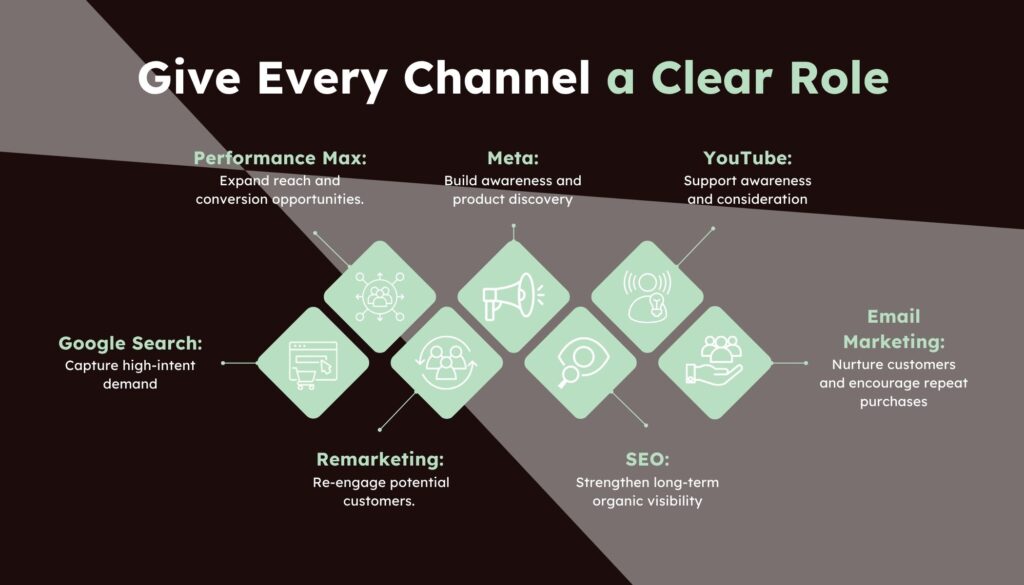
Give Every Channel a Clear Role
Customers rarely purchase after a single interaction.
Effective cross-channel marketing ensures that each platform supports a specific stage of the buying journey.
- Google Search: Capture high-intent demand.
- Performance Max: Expand reach and conversion opportunities.
- Meta: Build awareness and product discovery.
- YouTube: Support awareness and consideration.
- Email marketing: Nurture customers and encourage repeat purchases.
- SEO: Strengthen long-term organic visibility.
- Remarketing: Re-engage potential customers.
Not every retailer needs every channel. Success depends on selecting the right platforms and ensuring they work towards shared commercial objectives.
Not every retailer needs every channel. The goal is to choose the ones that suit how your customers shop and make sure they work together rather than in isolation.
Getting that balance right is what helps businesses drive online sales consistently over time.
Make Sure Your E-Commerce Experience Can Convert the Demand
Generating traffic means little if your website cannot convert it. Before peak periods, assess:
- Mobile usability and page speed: Fast, user-friendly pages help reduce drop-offs.
- Promotional landing pages: Ensure offers and campaigns have dedicated pages ready to convert.
- Product availability and information: Accurate stock levels and product details build trust and prevent lost sales.
- Site navigation and checkout: Make it easy for customers to find products and complete purchases.
- Conversion tracking: Ensure data is being tracked correctly so performance can be measured and optimised.
Product pages deserve particular attention. A well-crafted product page, with clear descriptions, quality imagery and compelling calls to action, helps customers make confident purchasing decisions.
Businesses can also strengthen their online stores with e-commerce development and Site Speed Optimisation, helping to create a smoother shopping experience, reduce customer drop-offs and improve conversion rates during peak demand periods.
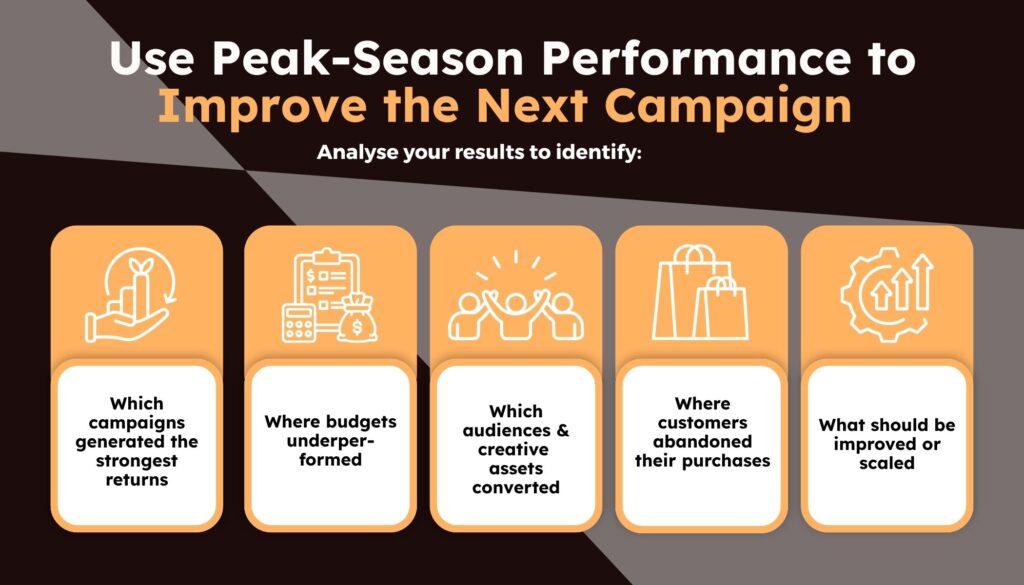
Use Peak-Season Performance to Improve the Next Campaign
Keep optimising campaigns after the promotion ends.
Analyse revenue, ROAS, CPA, conversion rates, average order value, customer acquisition and channel performance.
Identify:
- Which campaigns generated the strongest returns
- Where budgets underperformed
- Which audiences and creative assets converted
- Where customers abandoned their purchases
- What should be improved or scaled
These insights strengthen future seasonal marketing campaigns and support smarter resource allocation.
Every peak period should provide a foundation for better performance during the next.
Make Every Part of Peak Season Work Together
Successful peak season marketing requires more than effective advertising. Strategy, creative, paid media, marketing channels, website performance, conversion optimisation and reporting must work together to achieve measurable commercial outcomes.
When these elements align, e-commerce businesses can capture demand more effectively, improve conversion performance and protect profitability during competitive trading periods.
Ruby Digital helps retailers connect these activities through integrated E-commerce Digital Marketing services focused on driving online sales.
Black Friday is one opportunity, not the entire strategy.
Brands that achieve sustainable growth anticipate demand, act on performance data, and optimise every stage of the customer journey. Peak-season success is not about outspending competitors. It is about out planning, out optimising and converting opportunities into profitable growth.