 Skip to content

Most businesses generate more leads than their sales teams can realistically prioritise. As marketing channels expand and campaigns become more sophisticated, the challenge is no longer attracting prospects. It is identifying which opportunities deserve immediate attention.
Yet many organisations continue treating every lead the same, despite significant differences in buying intent and sales readiness.
Traditional lead qualification is often:
- Manual
- Inconsistent
- Based on assumptions rather than data
As a result, sales teams can spend valuable time pursuing prospects that are unlikely to convert, while high-value opportunities wait for engagement. The impact is clear:
- Wasted sales effort
- Slower sales cycles
- Missed revenue opportunities
Businesses need a smarter way to identify which prospects are most likely to become customers before investing significant sales resources.
This is where artificial intelligence is transforming lead management.
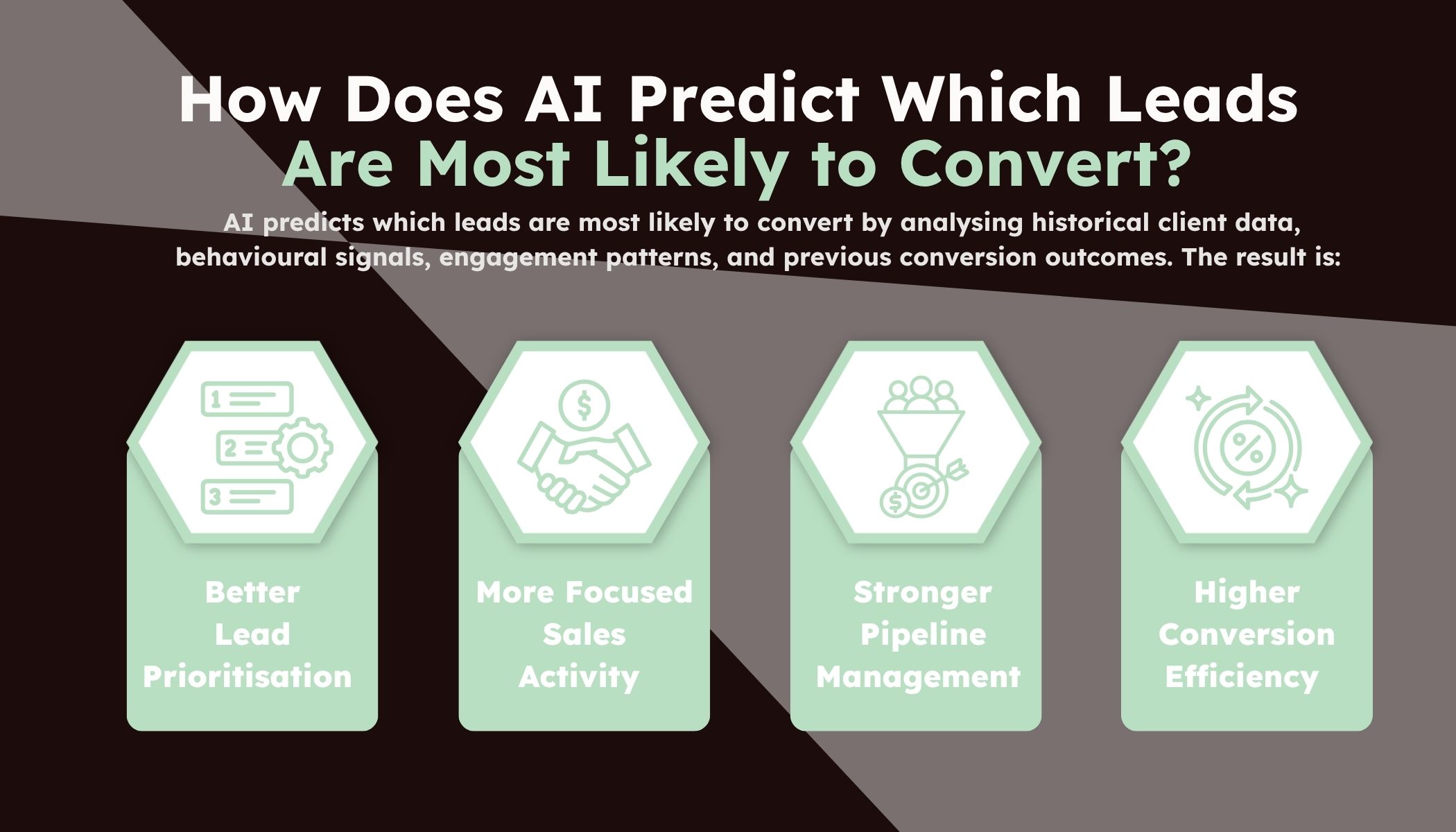
How Does AI Predict Which Leads Are Most Likely to Convert?
AI predicts which leads are most likely to convert by analysing historical client data, behavioural signals, engagement patterns, and previous conversion outcomes.
Rather than relying on assumptions, AI evaluates real performance data to identify the characteristics shared by successful clients. It continuously learns from new information, making its predictions increasingly accurate over time.
The result is:
- Better lead prioritisation
- More focused sales activity
- Stronger pipeline management
- Higher conversion efficiency
Instead of treating every opportunity equally, businesses can focus on the prospects with the greatest potential to generate revenue.
Why Traditional Lead Scoring Often Falls Short
Traditional lead scoring has been used for years to help prioritise prospects, but many conventional approaches struggle to keep up with today’s buying behaviour.
Most scoring systems rely on static criteria such as:
- Job title
- Company size
- Form submissions
- Demographic information
While useful, these factors rarely tell the complete story.
A prospect may perfectly match an ideal customer profile yet show little interest in purchasing. Another may demonstrate strong buying intent but receive a lower score because they fall outside predefined criteria.
Static scoring reflects assumptions.
AI evaluates real behaviour.
By analysing engagement patterns instead of relying solely on fixed rules, AI helps businesses focus on opportunities that are genuinely progressing towards a purchasing decision.
What Businesses Require to Make the Most of AI Lead Scoring
AI-powered lead scoring delivers the best results when strong data, aligned teams, and ongoing optimisation support it. The right foundations enable businesses to prioritise high-value opportunities with greater accuracy and confidence.
High-Quality Data Is the Foundation
AI is only as effective as the data it learns from. Poor-quality data leads to unreliable predictions.
Businesses should maintain:
- Accurate CRM records
- Clean contact databases
- Consistent opportunity tracking
- Reliable conversion tracking
Without quality data, even advanced predictive lead scoring machine learning models cannot produce meaningful insights.
Sufficient Historical Performance Data
AI learns by analysing previous outcomes. The more representative the historical data, the stronger its predictions become.
Businesses should track:
- Converted leads
- Lost opportunities
- Deal values
- Sales cycle lengths
This enables AI to recognise patterns shared by high-converting prospects and continuously improve lead-scoring accuracy.
Clear Definitions of a Qualified Lead
Sales and marketing must agree on what defines a qualified opportunity, including:
- Marketing Qualified Leads (MQLs)
- Sales Qualified Leads (SQLs)
- Opportunity criteria
- Conversion stages
Clear definitions provide consistent training data, resulting in a more reliable lead scoring model.
Integrated Systems and Data Sources
AI performs best when it can analyse data from multiple connected sources, including:
- CRM platforms
- Marketing automation tools
- Website analytics
- Advertising platforms
- Customer engagement tools
A connected data ecosystem gives AI a more complete view of prospect behaviour and buying intent.
Strong Sales and Marketing Alignment
Effective AI lead scoring depends on collaboration.
Sales provides feedback on lead quality, while marketing identifies the campaigns generating the strongest opportunities. Together, they improve:
- Lead prioritisation
- Lead handover
- Scoring accuracy
Human Oversight and Continuous Refinement
AI should support decision-making, not replace it.
Markets and buyer behaviour change, so businesses should regularly review:
- Scoring accuracy
- Conversion rates
- Pipeline progression
- Revenue outcomes
Combining AI insights with human expertise ensures the lead scoring model continues to improve, helping businesses focus on the opportunities most likely to convert and generate revenue.
How AI Analyses Historical Data to Identify Conversion Patterns
One of AI’s greatest strengths is its ability to analyse large volumes of historical data quickly and objectively.
Instead of relying on assumptions, AI reviews CRM records, sales outcomes, conversion histories, revenue performance, and sales cycle lengths to identify the characteristics shared by successful customers. It looks beyond individual data points to uncover patterns that consistently lead to conversions.
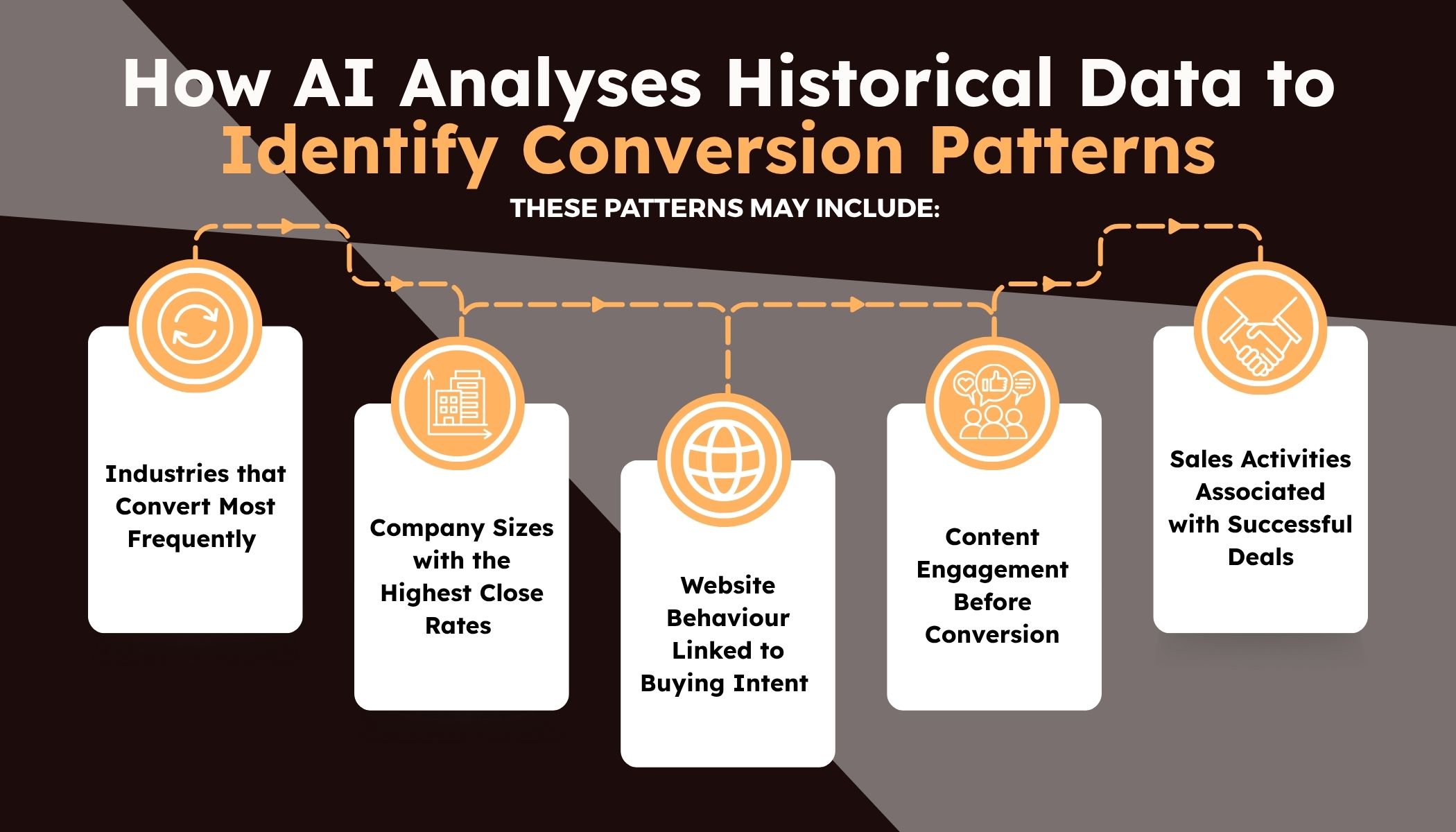
These patterns may include:
- Industries that convert most frequently
- Company sizes with the highest close rates
- Website behaviour linked to buying intent
- Content engagement before conversion
- Sales activities associated with successful deals
Over time, AI learns which combinations of behaviours and characteristics are most likely to result in revenue, allowing businesses to prioritise prospects with greater confidence.
The Signals AI Uses to Score Leads
A modern lead scoring model evaluates multiple signals rather than relying on a handful of static attributes.
Behavioural signals reveal how prospects interact with a business, including website visits, product page views, repeat visits, and overall engagement.
Engagement signals provide further insight through activities such as:
- Email opens and clicks
- Webinar attendance
- Content downloads
Firmographic signals help determine whether a prospect is a good commercial fit by evaluating factors such as industry, company size, revenue range, and location.
Sales interaction signals often indicate strong purchase intent and may include:
- Meeting requests
- Demo bookings
- Proposal engagement
- Response times
Rather than scoring each action in isolation, AI identifies patterns across multiple signals. A single content download may have limited value, but when combined with repeat website visits, demo requests, and consistent engagement, it can indicate a highly qualified opportunity.
This data-driven approach makes lead scoring significantly more accurate than traditional rule-based methods.
Why AI Lead Scoring Improves Pipeline Efficiency
One of the greatest advantages of analysing AI leads is improved pipeline efficiency.
When sales teams know which opportunities deserve immediate attention, they can allocate their time and resources more effectively.
The benefits include:
- Prioritising high-probability opportunities
- Reducing time spent on poor-fit prospects
- Responding faster to valuable leads
- Improving sales productivity
This creates stronger conversion rates, lower acquisition costs, and a healthier pipeline.
From Lead Quantity to Lead Quality
Successful growth is rarely driven by generating more leads alone.
Businesses often achieve better results by identifying and nurturing the right prospects instead of increasing lead volume.
AI helps organisations identify:
- High-intent prospects
- Sales-ready opportunities
- Accounts with the greatest revenue potential
This shifts the focus from measuring marketing success by the number of leads generated to measuring how effectively those leads convert.
Quality, supported by intelligent prioritisation, consistently delivers stronger commercial outcomes than volume alone.
How AI Supports Sales & Marketing Alignment
One of the most valuable benefits of AI-powered lead scoring is its ability to align sales and marketing around the same data.
Rather than relying on separate definitions of lead quality, both teams gain a shared understanding of which prospects are most likely to convert.
Marketing can see:
- Which campaigns generate high-quality leads
- Which channels drive conversions
- Which audience segments perform best
Sales teams receive:
- Prioritised opportunities
- Richer lead insights
- More accurate qualification data
This shared view improves communication, strengthens pipeline management, and helps both teams focus on revenue rather than activity. When decisions are based on data instead of assumptions, collaboration becomes more effective, and opportunities move through the pipeline faster.
How Ruby Digital Approaches AI-Driven Lead Qualification
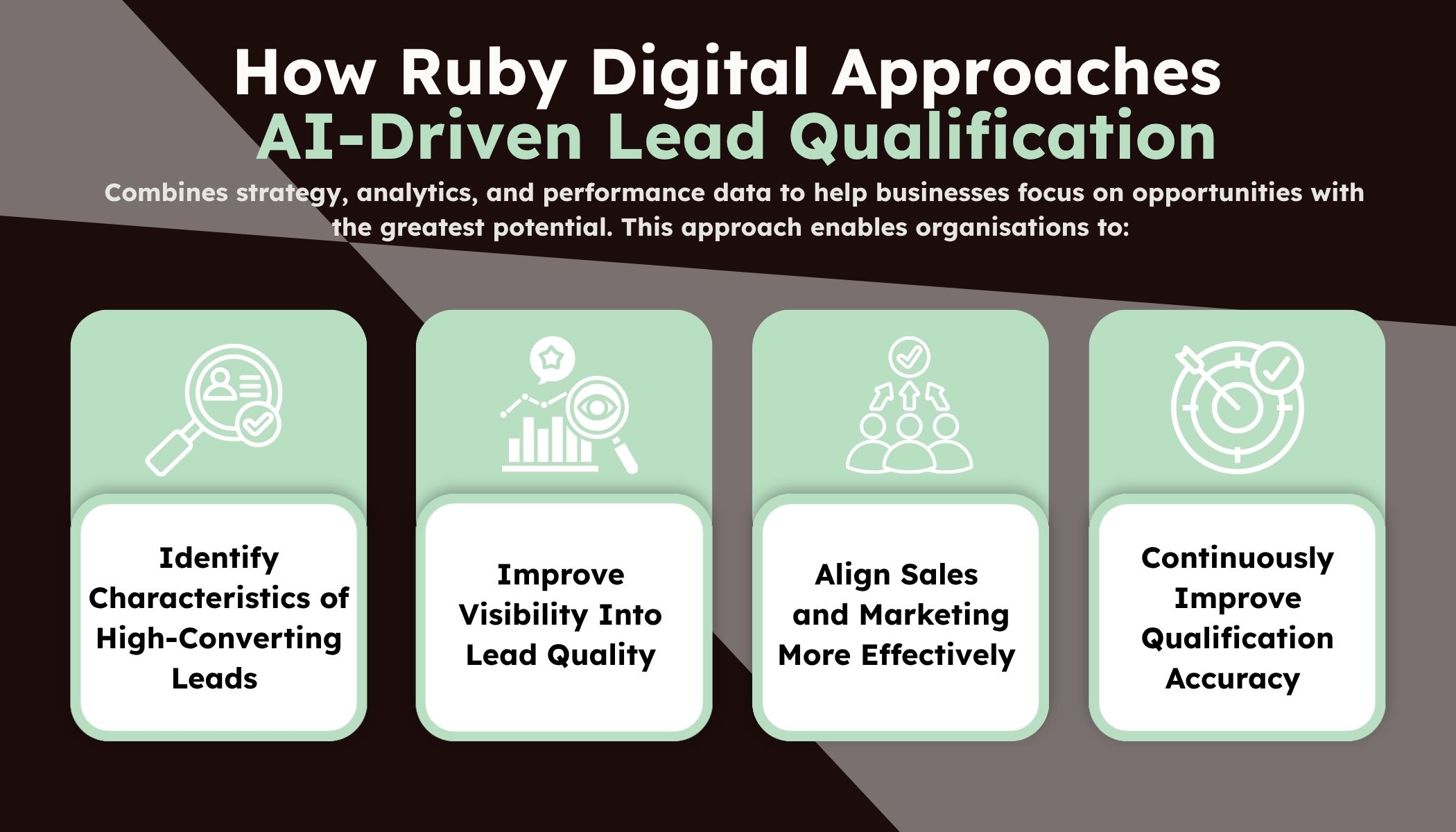
At Ruby Digital, AI-powered lead qualification combines strategy, analytics, and performance data to help businesses focus on opportunities with the greatest potential.
By analysing behavioural insights, CRM intelligence, campaign performance, and conversion data, businesses can better understand what defines a high-value prospect and continually refine their lead scoring model.
This approach enables organisations to:
- Identify characteristics of high-converting leads
- Improve visibility into lead quality
- Align sales and marketing more effectively
- Continuously improve qualification accuracy
The objective is simple: invest time and resources where they are most likely to generate measurable business results. Combined with AI SEO and GEO strategies, AI-driven qualification supports stronger lead acquisition and better lead prioritisation.
The Future of Lead Management Is Predictive
As AI adoption accelerates, lead management is shifting from reactive qualification to predictive decision-making.
Instead of manually assessing every prospect, businesses can use predictive lead scoring and machine learning to identify buying intent earlier, prioritise opportunities automatically, and improve revenue forecasting.
This evolution moves lead management beyond:
- Manual qualification
- Basic segmentation
- Reactive assessment
Towards:
- Predictive intelligence
- Automated prioritisation
- Revenue-focused forecasting
Businesses that embrace predictive technologies will be better positioned to identify valuable opportunities before their competitors and respond while buying intent is at its highest.
Focus Where Conversion Is Most Likely
The principle behind AI-powered lead scoring is straightforward.
Rather than treating every prospect equally, businesses can use AI lead analysis to identify which opportunities are most likely to convert and focus their efforts accordingly.
Organisations that prioritise the right leads consistently achieve:
- Higher conversion rates
- Greater sales efficiency
- Improved ROI
- More predictable revenue growth
The future of lead management is not about generating the largest volume of leads. It is about recognising the opportunities with the greatest potential and acting on them with confidence.
Businesses that combine AI insights with strategic sales and marketing expertise can improve pipeline quality, strengthen conversion performance, and create a more efficient path to sustainable growth.