 Skip to content

Every business reaches the same critical question when planning a marketing budget: how much should we invest in performance marketing?
In 2026, this question carries more weight than ever. Rising acquisition costs, increased competition, and more complex attribution models mean that reactive spending is no longer sustainable.
Yet many organisations still approach performance marketing investment without a clear framework. Budgets are increased without a strategy or reduced out of uncertainty, leading to inconsistent results.
The reality is straightforward. Effective paid media budget planning must be aligned with business goals, funnel stages, and measurable outcomes.
A strong digital advertising budget connects four key elements:
Budget → Channels → Growth Goals → ROI → Scale
When these elements are aligned, performance marketing becomes predictable, measurable, and scalable.
What a Performance Marketing Budget Really Includes
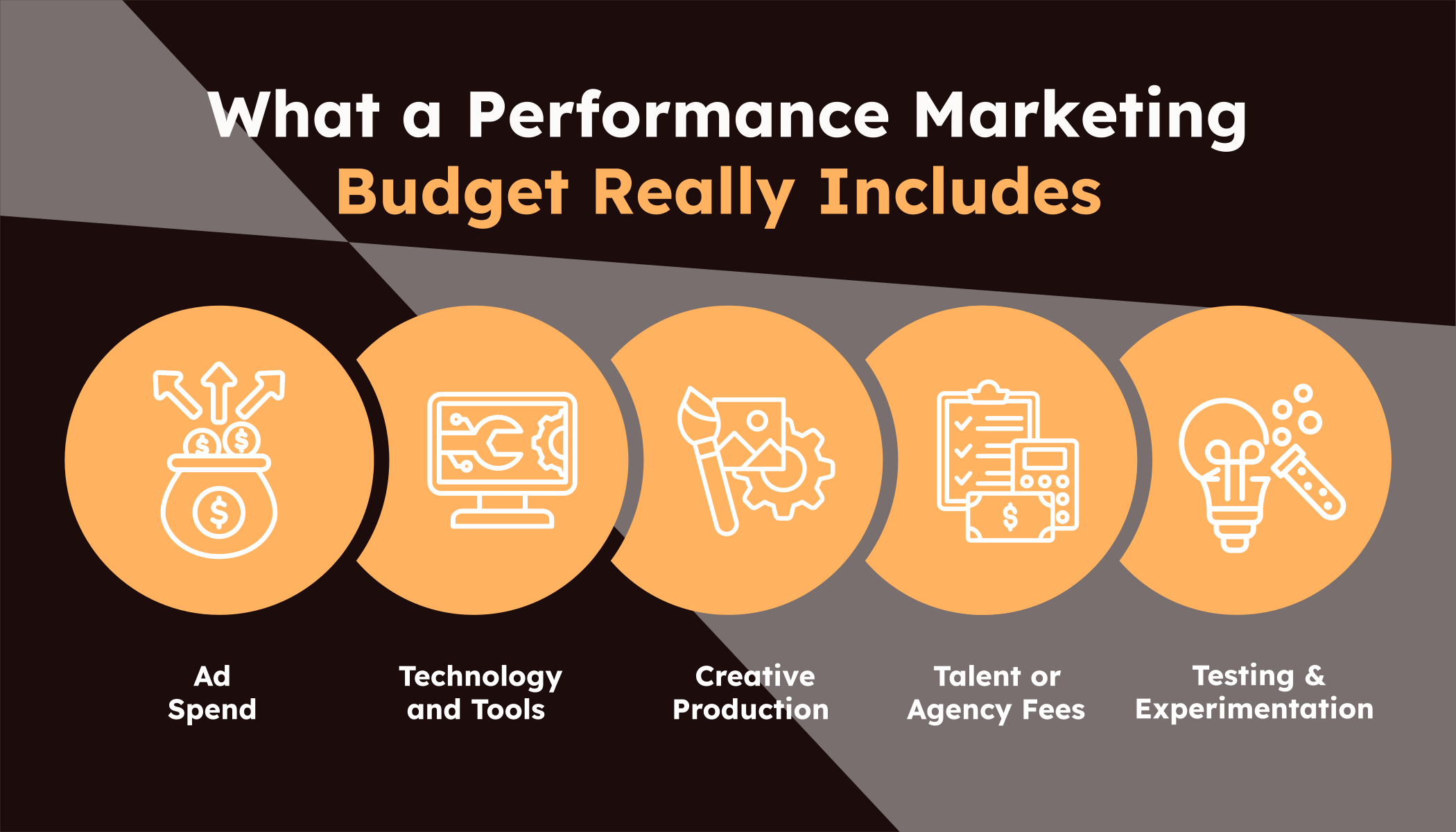
A common misconception is that a digital advertising budget only refers to media spend. In reality, a high-performing system includes multiple cost components working together.
Ad Spend
This is the direct investment in platforms such as Google, Meta, YouTube, and programmatic networks. It is the most visible part of your performance marketing costs, but not the only one.
Technology and Tools
Tracking platforms, analytics tools, attribution software, and automation systems all influence how efficiently your campaigns perform. These tools are essential for improving digital marketing ROI. In addition, the right technology drastically reduces wasted spend by ensuring accurate data, real‑time optimisation, and better audience insights. Without reliable tools, teams make slower, less-informed decisions, which ultimately limits scale and performance.
Creative Production
Performance marketing depends on strong creative. Landing pages, video assets, ad copy, and design all contribute to conversion rates. Without this layer, media spend underperforms.
Talent or Agency Fees
Specialists are required to manage strategy, testing, optimisation, and reporting. Whether internal or external, this expertise is a core part of your performance marketing investment. Experienced talent is essential because platforms are increasingly complex, and effective performance marketing requires analytical skill, technical knowledge, and creative insight. Without the right experts, even large budgets fail to produce sustainable results.
Testing and Experimentation
Testing is not optional. Budget must be allocated to allow for A/B testing, audience exploration, and creative variations. This is how campaigns improve over time and how efficiency is unlocked. Continuous testing helps identify what truly drives performance, enabling you to reduce CPA, increase conversion rates, and scale profitably. Every test produces learnings that compound over time, making your campaigns smarter and more cost‑efficient.
In short, your marketing budget must support the full ecosystem, not just ad placements. Strong paid media budget planning accounts for every component that drives revenue.
How Much Should Businesses Realistically Invest?
There’s no one-size-fits-all number, but there is a clear structure for calculating a realistic digital advertising budget.
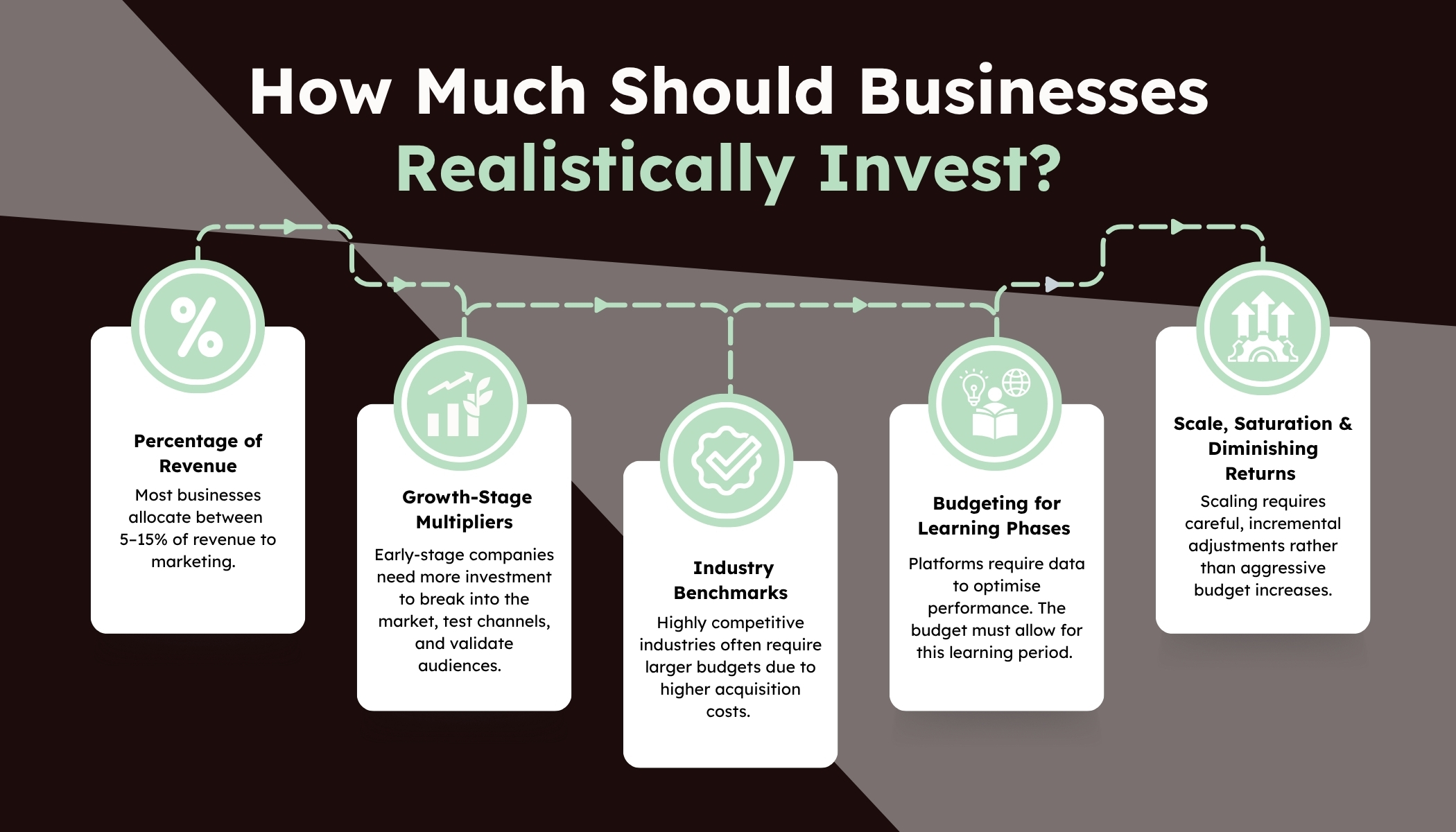
1. Percentage of Revenue
Most businesses allocate between 5–15% of revenue to marketing.
- Established businesses: 5–10%
- Growth-focused businesses: 10–15%
- High-velocity startups: 15–25% (higher CAC tolerance)
Your performance marketing investment should reflect how aggressively you want to grow.
2. Growth-Stage Multipliers
Early-stage companies need more investment to break into the market, test channels, and validate audiences.
3. Industry Benchmarks
Highly competitive industries such as e-commerce, SaaS, and finance often require larger budgets due to higher acquisition costs.
4. Budgeting for Learning Phases
Campaigns do not deliver strong digital marketing ROI immediately. Platforms require data to optimise performance. The budget must allow for this learning period.
5. Scale, Saturation & Diminishing Returns
As spend increases, efficiency can plateau. Scaling requires careful, incremental adjustments rather than aggressive budget increases.
The key takeaway is simple. Your marketing budget should reflect your growth ambition and market reality, not arbitrary numbers.
Matching Performance Marketing Channels to Business Goals
Effective paid media budget planning starts with your objective, not the platform.
If Your Goal Is Lead Generation
High-performing channels include:
- Google Search campaigns
- Meta lead generation campaigns
- LinkedIn for B2B targeting
- Conversion-focused landing pages
These channels capture high-intent users and provide measurable cost-per-lead performance.
If Your Goal Is Revenue / Sales
Best-performing channels include:
- Google Shopping and Performance Max
- Retargeting across Meta and display networks
- CRM-driven remarketing
- Affiliate or performance partnerships
These channels sit closest to the point of purchase and directly impact revenue.
If Your Goal Is Brand Awareness
Recommended channels include:
- Paid social video campaigns
- YouTube advertising
- Influencer partnerships
- Programmatic display
These channels maximise reach and build familiarity, supporting future conversion.
If Your Goal Is Full-Funnel Growth
A balanced approach across:
- Search
- Social
- Conversion Rate Optimisation
- Email marketing
- Content strategy
This creates a sustainable digital media mix that supports long-term performance.
For businesses looking to execute across these channels, services such as Google Ads, Meta Ads, and Search Engine Optimisation play a central role in building a connected strategy.
The ROI Question: What Return Should You Expect?
Measuring return on marketing investment is essential for performance-driven growth, but expectations must be realistic.
1. ROI is Industry-Specific
Different industries have different customer acquisition costs, lifetime values, and sales cycles. Benchmarks vary widely.
2. Early Phases Rarely Show Profit
The initial phases focus on data collection and optimisation. Strong digital marketing ROI develops over time.
3. Incrementality Matters
The key question is not just performance, but impact. Did your campaigns generate new revenue or simply capture existing demand?
4. CAC, ROAS & MER Metrics
Measure results at:
- Campaign level
- Channel level
- Full-funnel level
5. Long-Term ROI Compounds
Owned data + retargeting + nurture sequences = rising ROI over time.
In other words, digital marketing ROI isn’t defined by one campaign; it’s built over months of smarter, data-driven optimisation.
How FxCMO Helps Organisations Make Smarter Budget Decisions
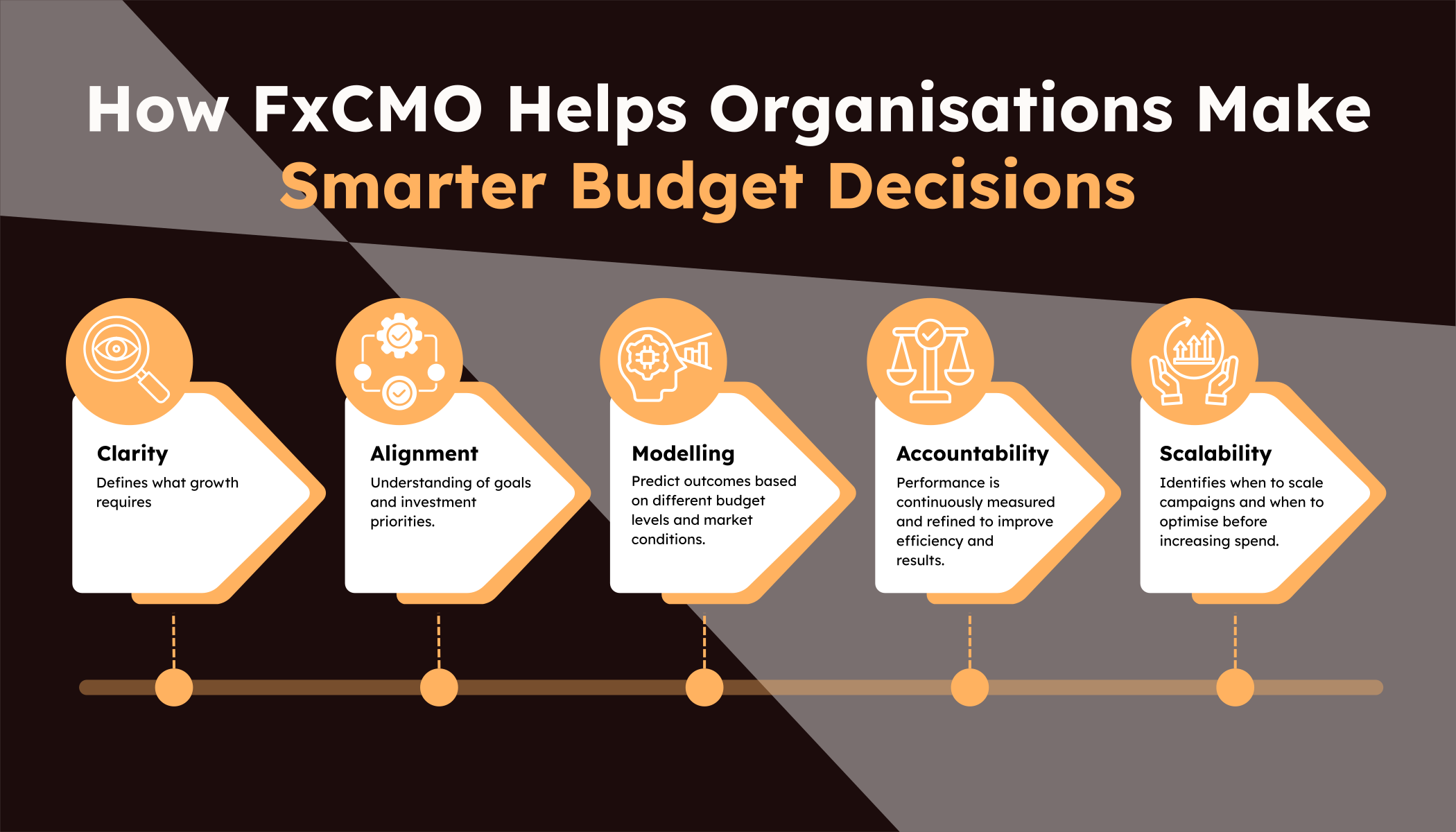
A Fractional Chief Marketing Officer (FxCMO) is Ruby Digital’s strategic framework designed to help leadership teams allocate budgets with confidence, not guesswork.
Clarity
FxCMO defines what growth requires in terms of budget, channels, and expected outcomes.
Alignment
Marketing, sales, and leadership teams operate with a shared understanding of goals and investment priorities.
Modelling
Scenario planning allows businesses to predict outcomes based on different budget levels and market conditions.
Accountability
Performance is continuously measured and refined to improve efficiency and results.
Scalability
The framework identifies when to scale campaigns and when to optimise before increasing spend.
Many businesses struggle not because their marketing budget is too small, but because it is misaligned. FxCMO drives every part of your digital advertising budget to contribute to measurable growth.
And if you need support implementing this model, Ruby Digital is ready to act as your FxCMO partner, giving you senior-level marketing strategy without the cost of a full-time CMO.
Invest with Strategy, Not Guesswork
Performance marketing in 2026 is not about spending more; it’s about spending smarter.
The right marketing budget is determined by:
- Your goals
- Your growth stage
- Your funnel maturity
- Your expected digital marketing ROI
Matching the right channels to the right outcomes maximises every rand works harder.
The right performance marketing budget is the one aligned to your business goals and supported by a system designed for accountability, efficiency, and long-term success.
FxCMO, powered by Ruby Digital, provides the strategic structure needed for clarity, alignment, and measurable growth.