 Skip to content

Artificial intelligence (AI) and automation are reshaping the modern workplace. From marketing analytics and customer service to content creation and reporting, tasks that once required hours of manual effort can now be completed in seconds.
Businesses are adopting automation to improve efficiency, increase accuracy, and scale operations faster than ever before. While these advances create exciting opportunities, they also raise an important question:
What Happens to the People Behind the Work?
As organisations pursue productivity gains and operational efficiencies, employees often face uncertainty around changing roles, evolving responsibilities, and the skills needed to succeed in an AI-driven environment.
This is where automation ethics becomes essential.
Modern organisations can no longer focus solely on implementing technology. They must also consider how that technology impacts their people. Ethical automation balances innovation with human development, ensuring progress strengthens teams rather than leaving them behind.
What Is the New Employer Responsibility?
In the age of automation, an employer’s responsibility extends beyond improving efficiency. It includes investing in training, upskilling, and support so that employees can work alongside AI and continue growing their careers.
This principle sits at the heart of AI ethics in business.
Ethical automation is not about slowing innovation. It is about managing change responsibly. Organisations that embrace this mindset recognise that people remain their greatest competitive advantage, even in highly automated environments.
The companies that thrive will be those that use technology to amplify human potential rather than replace it.
Why Automation Without Responsibility Creates Risk
When automation is pursued without considering its human impact, organisations introduce significant risks.
Employees who feel threatened by automation are less likely to embrace new systems. Rather than accelerating innovation, poorly managed change often creates resistance, uncertainty, and reduced engagement.
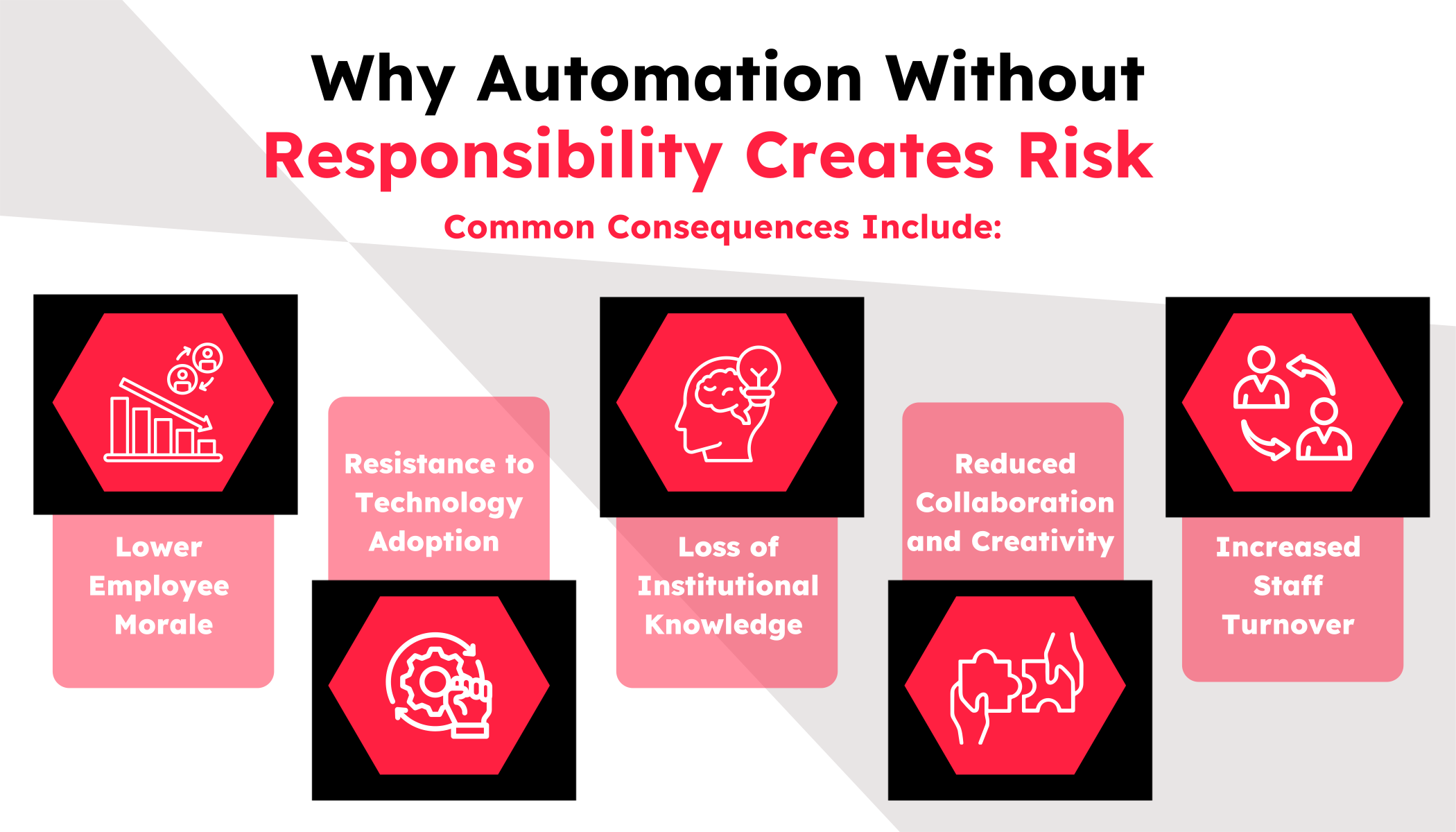
Common consequences include:
- Lower employee morale
- Resistance to technology adoption
- Loss of institutional knowledge
- Reduced collaboration and creativity
- Increased staff turnover
Disengagement is particularly damaging. When people feel replaceable, they naturally become less invested in their work. This affects productivity, innovation, and client outcomes.
There are also reputational risks. Organisations that ignore AI automation ethics may struggle to attract and retain top talent. In a competitive employment market, responsible AI practices are becoming an important part of employer branding.
The Shift from Replacement to Augmentation
The most successful organisations are reframing their approach to automation.
Rather than replacing employees, they are using AI to enhance human capabilities.
AI excels at:
- Processing large amounts of data
- Automating repetitive tasks
- Identifying patterns quickly
- Generating insights at scale
Humans bring strengths that technology cannot replicate:
- Strategic thinking
- Creativity
- Emotional intelligence
- Relationship building
- Complex decision-making
When these capabilities work together, organisations unlock greater value than either could achieve independently.
This shift from replacement to augmentation is a core principle of AI ethics and governance.
For example, within digital marketing, AI can analyse campaign performance and identify opportunities, while human specialists refine messaging, shape strategy, and build client relationships. The strongest outcomes emerge when technology supports expertise rather than replacing it.
Services like SEO strategy, AI-driven optimisation, and Google Ads management all benefit from this collaborative model.
The Ethical Pillars of Automation in Modern Workplaces
Successful automation strategies are built on a foundation of ethical principles.
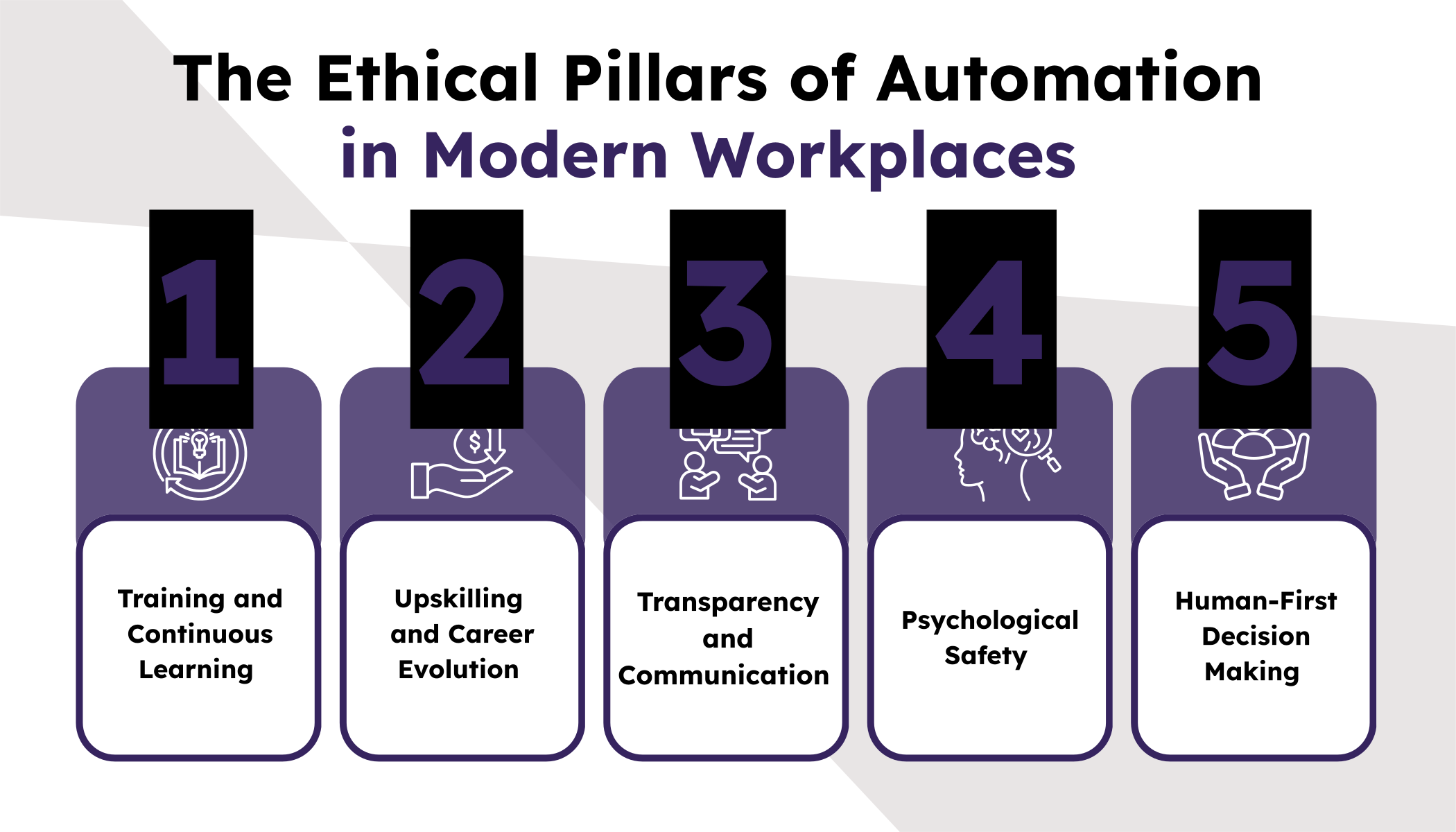
1. Training and Continuous Learning
Employees need the skills to work confidently alongside AI tools.
Training should not be treated as a once-off initiative. As technology evolves, learning must become an ongoing part of workplace culture.
Organisations that invest in continuous development create teams that are adaptable, confident, and future-ready.
2. Upskilling and Career Evolution
Automation changes roles. Ethical employers help employees evolve alongside these changes.
This means creating clear pathways for career growth, developing new skills, and preparing teams for emerging opportunities.
When people can see a future within the organisation, uncertainty gives way to confidence.
3. Transparency and Communication
Employees deserve to understand how AI is being used and why.
Clear communication reduces fear, builds trust, and encourages engagement with new technologies.
Transparency is a critical component of responsible AI ethics in business.
4. Psychological Safety
Innovation requires experimentation.
Employees must feel comfortable exploring new tools, testing ideas, and learning from mistakes without fear of judgement.
Organisations that create psychological safety accelerate adoption and encourage continuous improvement.
5. Human-First Decision Making
Every automation initiative should be evaluated through a human lens.
Before implementing new systems, leaders should ask:
- How will this affect our people?
- What support will be required?
- How can we create opportunities rather than uncertainty?
This human-first mindset sits at the core of effective automation ethics.
Why People-First Automation Drives Better Results
Businesses that invest in both people and technology consistently outperform those that focus on technology alone.
When employees receive the right support:
- Productivity improves
- Innovation increases
- Engagement strengthens
- Retention rises
- Collaboration becomes more effective
Well-trained employees also use AI more effectively, generating stronger outcomes across every area of the business.
This is particularly evident in digital marketing, where AI-powered insights combined with human expertise create more impactful strategies and better results.
People-first automation is not simply good leadership. It is smart business.
What Ethical Automation Looks Like in Practice
Ethical automation can be implemented through practical, measurable actions.
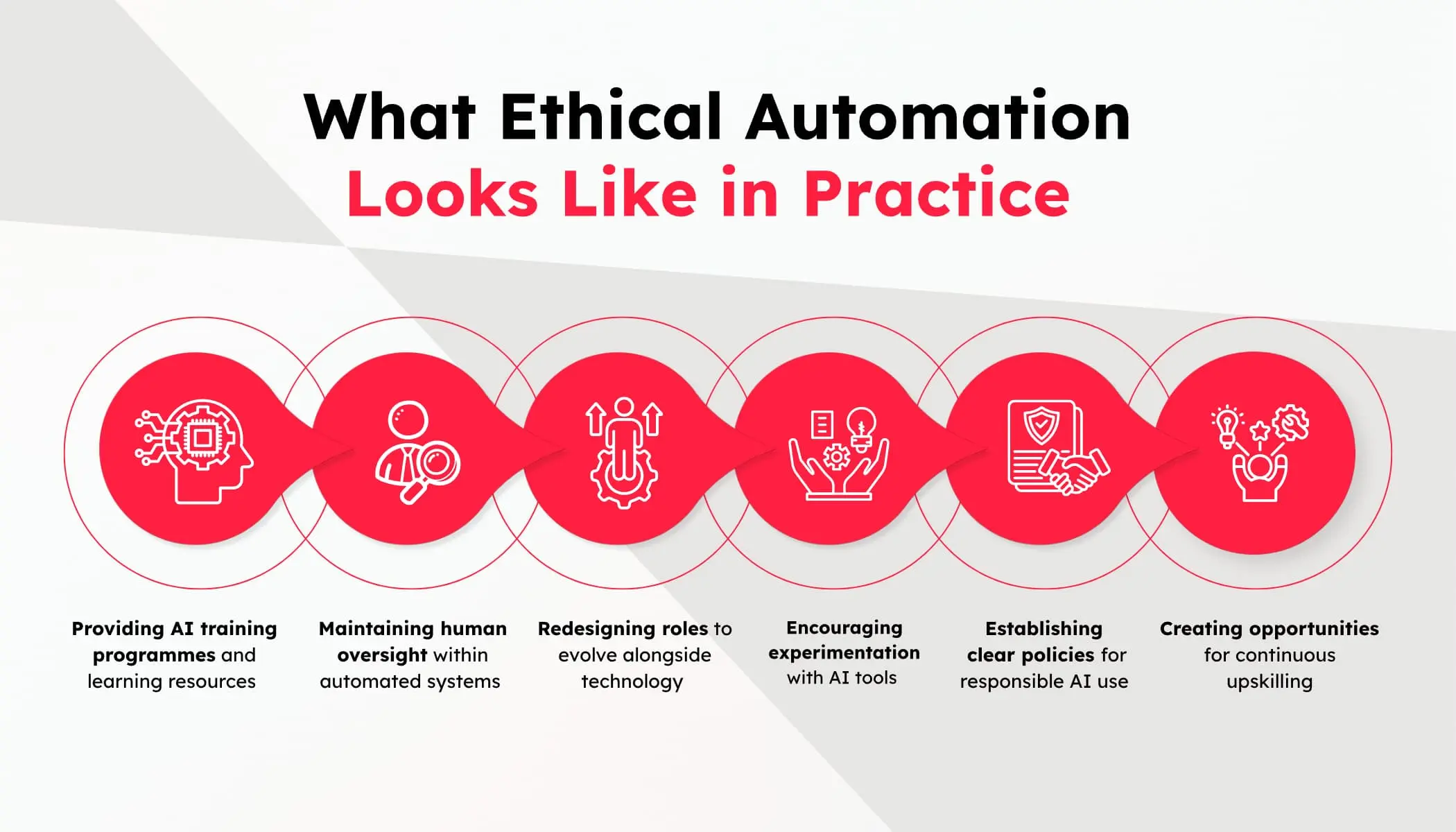
Examples include:
- Providing AI training programmes and learning resources
- Maintaining human oversight within automated systems
- Redesigning roles to evolve alongside technology
- Encouraging experimentation with AI tools
- Establishing clear policies for responsible AI use
- Creating opportunities for continuous upskilling
These initiatives demonstrate a commitment to both innovation and employee growth.
They also strengthen AI ethics and governance by ensuring technology is implemented with accountability, transparency, and purpose.
For marketers looking to stay ahead, understanding how AI influences search visibility, including ranking in large language models, is increasingly important. Resources like this guide on ranking in ChatGPT and LLMs highlight how AI is reshaping digital strategy.
How Ruby Digital Puts Ethical Automation into Action
Ruby Digital demonstrates how ethical automation can become part of everyday business operations.
Empowering Teams Through AI Access
Every team member has access to AI tools and is encouraged to explore how they can improve workflows, solve challenges, and increase efficiency.
Rather than limiting experimentation, Ruby Digital creates opportunities for employees to discover what works best for them.
Creating a Culture of Exploration
Employees are encouraged to test new tools, automate repetitive tasks, and identify creative ways to improve outcomes.
This culture of curiosity allows innovation to emerge naturally while creating a safe environment for learning.
Sharing Knowledge Across the Business
AI insights, resources, and discoveries are shared openly throughout the organisation.
Knowledge is not confined to individual departments. Instead, it becomes a collective asset that benefits everyone.
Building AI Literacy Across All Roles
Every team member engages with AI at some level, regardless of their role.
This approach creates a strong baseline understanding while allowing individuals to develop specialised expertise as their responsibilities evolve.
Supporting Continuous Growth
The focus is not simply on AI adoption. It is on helping people grow alongside technology.
By investing in learning and development, Ruby Digital ensures employees remain empowered, relevant, and equipped for the future.
This approach embodies the principles of AI automation ethics in action.
The Competitive Advantage of Ethical Employers
Ethical automation is more than a moral responsibility. It is a powerful competitive advantage.
Organisations that invest in their people benefit from:
- Higher productivity
- Stronger innovation
- Greater employee loyalty
- Better talent attraction
- Enhanced brand reputation
Trust becomes a differentiator.
Employees trust organisations that invest in their growth. Clients trust organisations that demonstrate responsible business practices. Together, these relationships create long-term resilience and sustainable success.
As automation becomes increasingly common, the way businesses manage change will become one of their greatest competitive advantages.
The Future of Work Belongs to Companies That Invest in People
Automation will continue to accelerate. The question is no longer whether organisations will adopt AI, but how they will do so.
The businesses that lead the future will be those that combine technological innovation with genuine investment in people.
By prioritising training, upskilling, transparency, and support, organisations create environments where both technology and talent can thrive.
The future of work belongs to companies that recognise a simple truth:
Technology may drive efficiency, but people drive progress.